Swedish audiobooksAnden or anden? Why Swedish is hard for AI narration.
Swedish spells two different words the same way and tells them apart with melody alone. A narrator has to know which one you meant.
Swedish is hard for AI narration because meaning depends on things the spelling does not show: a tonal word accent that separates words like anden (the duck) and anden (the spirit), vowel length that separates glas (glass) from glass (ice cream), and compound words whose meaning changes if they are split. A good Swedish narrator works these out from context, sentence by sentence.
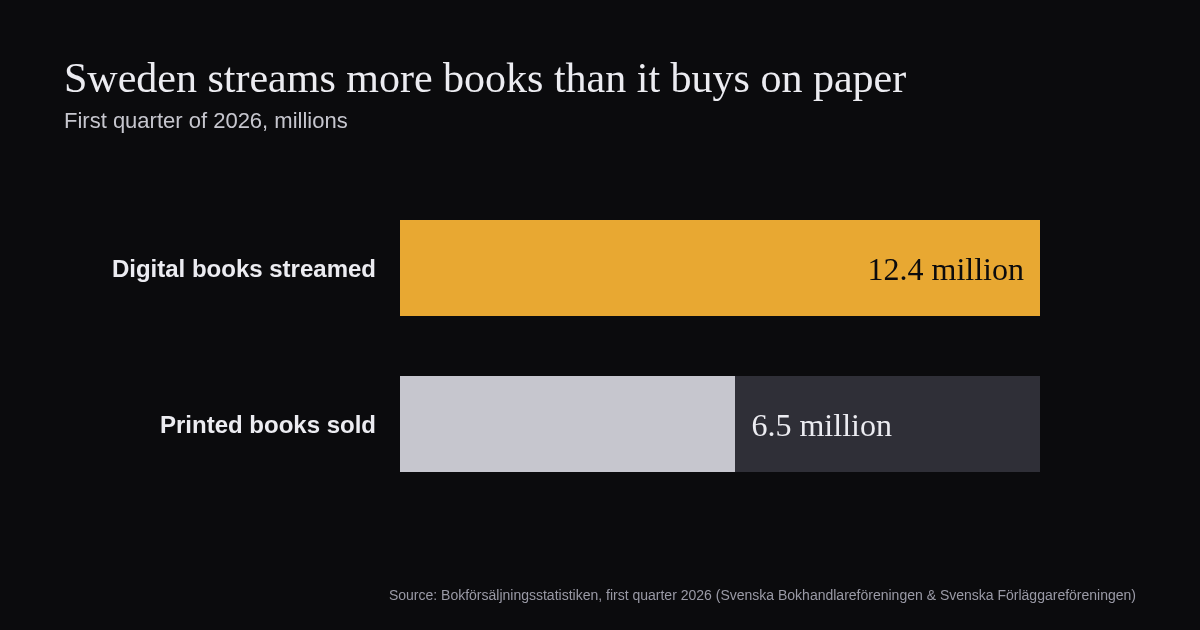
In the first quarter of 2026, Swedes streamed 12.4 million digital books and bought 6.5 million printed ones, according to the Swedish booksellers’ and publishers’ associations. Digital subscription services took 34.4% of all book sales revenue, and they were the fastest-growing channel. Sweden is the home of Storytel and one of the most audiobook-minded book markets in the world, which makes Swedish listeners some of the hardest to please. They have heard thousands of hours of professional narration, and they notice when a voice gets Swedish wrong.
What is the Swedish word accent, and why does it matter?
Swedish has two word accents, a single-peaked melody (accent 1) and a double-peaked one (accent 2), and some words differ only by which one they get. Anden with accent 1 is “the duck”; with accent 2 it is “the spirit”. Tanken is “the tank” or “the thought”, and tomten is “the plot of land” or the Christmas gnome. Nothing in the spelling tells them apart. A narrator, human or machine, has to understand the sentence to choose the right melody.
Most of the time a wrong accent does not change the meaning, but it does change the sound: Swedish with the wrong melody sounds foreign, the way English with stress on the wrong syllable does. Over a ten-hour book, that is the difference between a narrator and a machine. Here is one sentence with both kinds of anden in it, read by one of our Performed voices:
Which Swedish sounds does English not have?
The sj-sound is the famous one: a breathy, rounded sound at the start of sjö (lake), sju (seven) and stjärna (star), with no English equivalent. It hides behind several spellings: sj, skj, stj, sk before a soft vowel as in skön, and -tion in words like station. Its softer cousin, the tj-sound, starts tjugo (twenty), kind (cheek) and kär (in love). The rule that k and sk soften before e, i, y, ä and ö has exceptions, so a narrator cannot read Swedish letter by letter.
Two more features trip up voices trained mostly on other languages. In most of Sweden, r followed by d, n, s, t or l merges into one sound, so barn, bord and först have no separate r in them. And vowel length changes words: glas (glass) has a long vowel, glass (ice cream) a short one; vit (white) and vitt differ the same way. A narrator who gets the length wrong is not just accented but, every so often, saying a different word.
Why do Swedish compound words matter so much?
Swedish writes compound words as one word, and the space between words carries meaning. The schoolbook example is brunhårig sjuksköterska, a brown-haired nurse; written as brun hårig sjuk sköterska it becomes a brown, hairy, sick nurse. A sign saying rökfritt means no smoking; rök fritt means smoke freely. Swedes call the mistake särskrivning, and a narrator reads it aloud exactly as written. A compound also takes its own melody, usually accent 2, so the same letters sound different as one word and as two.
Manuscripts converted from PDF are where this goes wrong in practice. Line breaks and hyphenation split compounds, and a split compound read aloud sounds like a typo you can hear. Abbreviations need the same care: t.ex., bl.a. and kl. 14.30 should be read as till exempel, bland annat and klockan fjorton och trettio, not letter by letter. Our guide to preparing a manuscript for AI narration covers the checks that catch these.
Whose Swedish should your audiobook speak?
Most Swedish audiobooks use standard Swedish, rikssvenska, which is closest to the speech of the Stockholm and Mälardalen region. Regional Swedish is strongly felt, though. Skåne in the far south uses a throaty r pronounced at the back of the mouth, like the French or German r, and has no merged r sounds. Gothenburg, Norrland, Småland and Gotland each have a recognisable melody. And Finland Swedish, spoken by Finland’s Swedish-speaking minority, has no tonal word accents at all, which makes it sound flatter and crisper to listeners in Sweden.
For most fiction, standard Swedish is the safe choice, because it is what listeners on Storytel, BookBeat and Nextory hear every day. A regional voice makes sense when the book is set in that region, when the narrator is a character from there, or when you are writing for Finland’s Swedish-speaking readers. If you are publishing in Swedish for the first time, our guides to making an audiobook in Swedish and to publishing on Storytel, Everand and Nextory cover the market.
How should you choose and check a Swedish voice?
TomeVox now offers Swedish in both of its voice ranges. Our Performed voices, which read the scene and shape their tone and pacing to it, include 12 Swedish voices with regional characters from Stockholm, Gothenburg, Skåne, Småland, Gotland, Norrland and Swedish-speaking Finland. Our Narrated voices read standard Swedish. Regional colour in a synthetic voice is subtler than in a person, so listen to a few voices before you choose. Performed vs Narrated explains the difference between the ranges.
Whichever voice you pick, check it on your own book: a passage with words that depend on their melody, a few long compounds, your characters’ names, and any abbreviations and times. Your first chapter is free in the voice you pick, before you pay anything. Narrated costs $49, $79 or $99 by book length; Performed costs $149, $229 or $299. If you are weighing a do-it-yourself tool, ElevenLabs’ self-serve app leaves the preparation, regenerations and checking to you, and on a full book we cost less. If you are weighing ElevenLabs Productions, their done-for-you service, we offer the same quality, if not better, for a fraction of the price and with a much faster turnaround.
In Swedish, the melody is part of the word. A narrator who reads the letters and not the sentence will get it wrong.
Hear your first chapter in Swedish. Free.
Narrated $49–$99+ · Performed $149–$299+, by book length. Upload your manuscript, pick a voice and listen before you pay. No card.
Hear your first chapter freeCommon questions about Swedish AI narration
Can AI narrate an audiobook in Swedish?
Yes. Modern AI voices handle Swedish pronunciation, including the sj-sound, merged r sounds and the two tonal word accents, when they read the sentence as a whole. Check any voice on your own manuscript before you commit, especially words whose meaning depends on their melody.
What is the Swedish pitch accent?
The Swedish pitch accent is a difference in word melody between accent 1 (one peak) and accent 2 (two peaks). It separates pairs spelled the same way, such as anden (the duck) and anden (the spirit), so a narrator has to choose from context.
Should a Swedish audiobook use standard Swedish or a regional accent?
Standard Swedish, close to the Stockholm region, suits most books and is what audiobook listeners in Sweden are used to. A regional voice suits books set in that region; Finland Swedish suits books for Finland’s Swedish-speaking readers.
Does TomeVox have Swedish AI voices?
Yes. TomeVox Performed has 12 Swedish voices with regional characters from across Sweden and Swedish-speaking Finland, and Narrated reads standard Swedish. The first chapter of your book is free to hear before you pay.