Spanish audiobooksWhich Spanish should your audiobook speak?
Spanish is one language with many voices. The right one depends on who is listening, and on the words you wrote.
Choose the Spanish accent of your largest audience: Castilian for readers in Spain, a neutral Latin American accent for the Americas and the US Hispanic market, and Rioplatense or Mexican Spanish when the book is set there. Then check that the manuscript matches: a voice changes pronunciation, but it reads your vosotros, vos and vocabulary exactly as written.
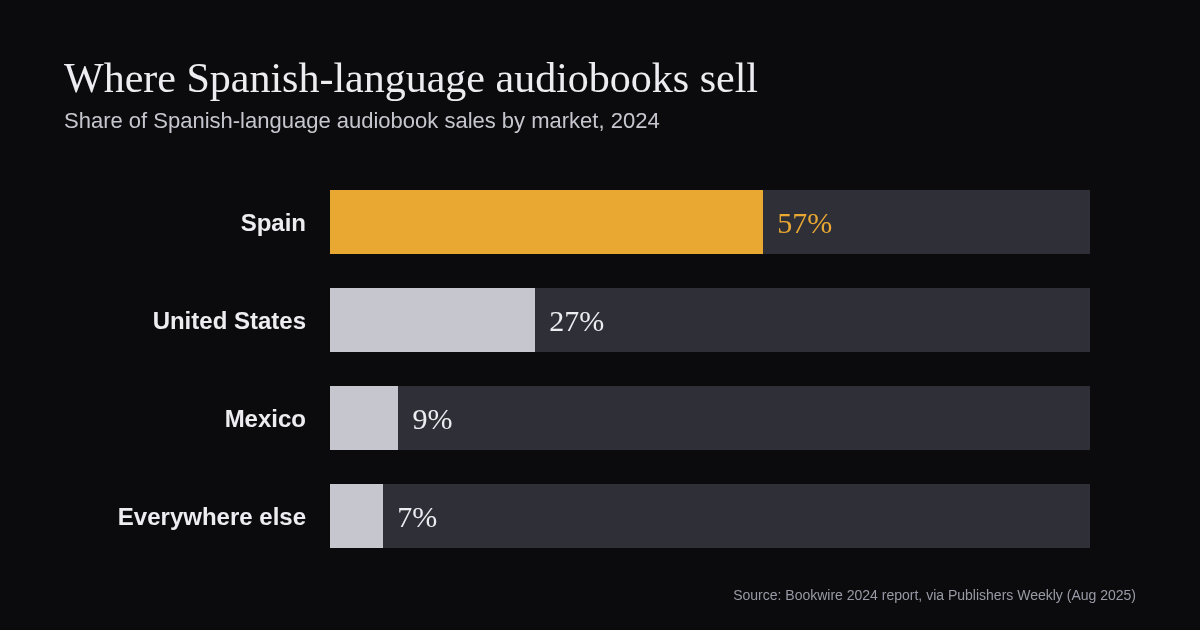
Spanish-language audiobook sales grew 37.8% in 2024, according to Bookwire figures reported by Publishers Weekly, and Spain alone accounted for 57% of those sales. The language behind them is enormous: the Instituto Cervantes counts about 635 million Spanish speakers, about 520 million of them native. That is the opportunity and the problem at once. A listener in Madrid and a listener in Buenos Aires both speak Spanish, and each can tell within one sentence whether the narrator is from home.
What actually differs between Spanish accents?
Three sounds do most of the work. The first is c and z. In most of Spain, caza (hunt) and casa (house) sound different, because z and soft c are said like the English th in think. Linguists call this distinción. In Latin America, the Canary Islands and much of Andalusia, both words are said with an s, which is called seseo. A Spanish narrator who says gracias with a th instantly sounds peninsular to a Mexican listener.
The second is ll and y. Almost all Spanish speakers now pronounce the two the same way, but Argentina and Uruguay pronounce both as a sh or zh sound, so calle sounds roughly like “cashe”. This Rioplatense feature is the most recognisable accent marker in the Spanish-speaking world. The third is the s at the end of a syllable, which is kept in Mexico, the Andes and central Spain, but softened to a breath or dropped in the Caribbean, Andalusia and much of the Southern Cone: los caballos becomes something like “loh caballoh”. Rhythm and melody differ too; Rioplatense intonation is often compared to Italian.
| Feature | Spain (Castilian) | Mexico | Argentina, Uruguay |
|---|---|---|---|
| z, soft c (plaza) | th sound | s | s |
| ll, y (calle) | y sound | y sound | sh or zh |
| Plural “you” | vosotros | ustedes | ustedes |
| Singular “you” | tú | tú | vos (vos tenés) |
| “Car” | coche | carro, coche | auto |
The table shows the pattern that matters for production: the top two rows are pronunciation, which a voice handles, and the bottom three are words on the page, which only the author can change.
What does the same sentence sound like in three accents?
The clearest way to hear the difference is one sentence read by three of our Performed voices. The sentence is built to show the differences: cocinera, hace and plaza test the c and z; llueve, calle and caballos test the ll.
All three clips are unedited, rendered with the same settings we use for audiobooks.
Why does the manuscript have to match the voice?
A narrator changes how words sound, not which words are there. A Castilian voice reading vos tenés razón sounds like a Spaniard quoting an Argentine; a Rioplatense voice reading vosotros tenéis sounds like an Argentine reading a book from Madrid. Neither is wrong, but both pull the listener out of the story. Pronouns are the biggest signal: vosotros is used only in Spain, and vos replaces tú in Argentina, Uruguay and much of Central America. Everyday vocabulary follows: ordenador or computadora, zumo or jugo, coche, carro or auto.
So the voice should match the Spanish the book is written in. If your translator wrote for Spain, a Castilian voice is the natural fit, even if you hope to sell in Mexico. If the book was written in neutral Latin American Spanish, the kind used in film dubbing, a neutral Latin American voice reads it most naturally across the Americas. Our guide to translating a book for an audiobook covers how to brief a translator on which Spanish to write.
Where does Spanish narration trip up?
Dialogue punctuation is the first trap. Spanish marks dialogue with a long dash, the raya, not with quotation marks, and the narrator’s words sit inside the same line: —Ya voy —dijo él—. Pero no me esperes. A listener has to hear where the character stops and the narrator starts, without any quotation marks to go on. Listen for this in any sample, because it is where machine narration most often runs a character’s words into the narrator’s.
Missing accent marks are the second. Spanish uses the written accent to show stress, and stress changes meaning: esta (this) is stressed on the first syllable, está (is) on the last; término, termino and terminó are three different words. Manuscripts that drop accents, especially on capital letters, make any narrator stress the wrong syllable, so a careful proofread for accents pays off directly in the audio. English names and loanwords are the third: a Spanish narrator should say Facebook or Jennifer the way a Spanish speaker would, not with a perfect American accent and not spelled out letter by letter. Our pronunciation guide covers how to list the names that matter.
How should you choose a Spanish voice for your audiobook?
Start with where your listeners are, then check it against your text. For a book written for Spain, choose a Castilian voice: Spain is more than half the market. For a book aimed at the US Hispanic market or Latin America as a whole, choose a neutral Latin American voice. Choose a Mexican or Rioplatense voice when the book is set there or written in that Spanish, especially if the characters say vos. If you are still deciding on markets, our guide to making an audiobook in Spanish covers the platforms that sell in each.
TomeVox now offers Spanish in both of its voice ranges. Our Performed voices, which read the scene and shape their tone and pacing to it, now include 12 Spanish voices: four from Spain (Castilian), four with a neutral Latin American accent, two from Mexico and two from Argentina. Our Narrated voices read Spanish in Castilian, Mexican, Caribbean, Chilean and Rioplatense accents. Performed vs Narrated explains the difference between the two.
Your first chapter is free in the voice you pick, so you can hear your own dialogue and names before paying anything. Narrated costs $49, $79 or $99 by book length; Performed costs $149, $229 or $299. If you are weighing a do-it-yourself tool, ElevenLabs’ self-serve app leaves the preparation, regenerations and checking to you, and on a full book we cost less. If you are weighing ElevenLabs Productions, their done-for-you service, we offer the same quality, if not better, for a fraction of the price and with a much faster turnaround.
Pick the Spanish your readers speak, and the Spanish your book is written in. Ideally they are the same.
Hear your first chapter in Spanish. Free.
Narrated $49–$99+ · Performed $149–$299+, by book length. Upload your manuscript, pick a voice and listen before you pay. No card.
Hear your first chapter freeCommon questions about Spanish audiobook accents
Should a Spanish audiobook use a Spain or a Latin American accent?
Use the accent of your main audience and of the Spanish your book is written in. Spain buys 57% of Spanish-language audiobooks, so a Castilian voice suits books written for Spain; a neutral Latin American voice suits books aimed at the Americas and the US Hispanic market.
What is neutral Latin American Spanish?
Neutral Latin American Spanish is an accent and vocabulary that avoids strong regional markers, with an s sound for z and no sh for ll. It is widely used in film dubbing, and listeners across Latin America and the United States accept it as unmarked.
Can an AI narrator change vosotros to ustedes?
No. A narrator reads the text as written, so pronouns like vosotros and vos and regional vocabulary have to be right in the manuscript. Change them in translation or editing, then pick a voice whose accent matches.
Does TomeVox have Spanish AI voices?
Yes. TomeVox Performed has 12 Spanish voices from Spain, Mexico, Argentina and neutral Latin America, and Narrated reads Spanish in Castilian, Mexican, Caribbean, Chilean and Rioplatense accents. The first chapter of your book is free to hear before you pay.