The Audiobook Nobody Made
Most books still don't exist in audio, in any language. What kept them silent was cost, and that just collapsed. But most of the audio rushing in to fill the gap is slop.
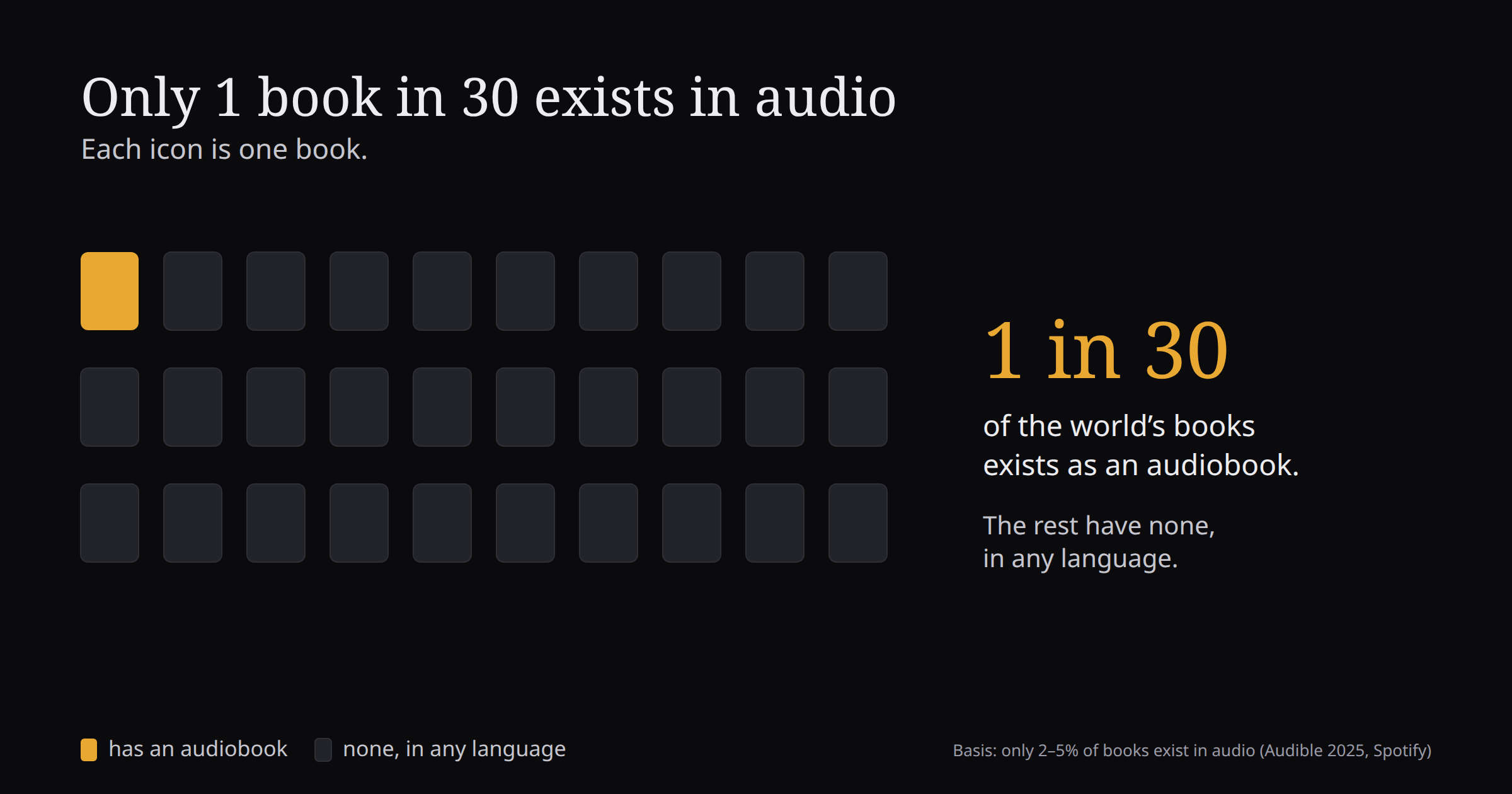
There are about 750,000 books in print in French. Roughly 20,000 of them exist as audiobooks. That's Spotify's own figure, and it's under three percent. The other 730,000 French books have no audio edition at all.
France isn't the exception. Audible's CEO, Bob Carrigan, said it plainly in 2025: only two to five percent of the world's books have ever been turned into audio. We talk about the audiobook boom as if the shelves are full and the only question is what to buy next. The shelves are nearly empty. They look full because the few thousand titles that get made are the ones marketed at you.
For fifteen years there was a clean reason for this, and the reason was money.
Why the shelf stayed empty
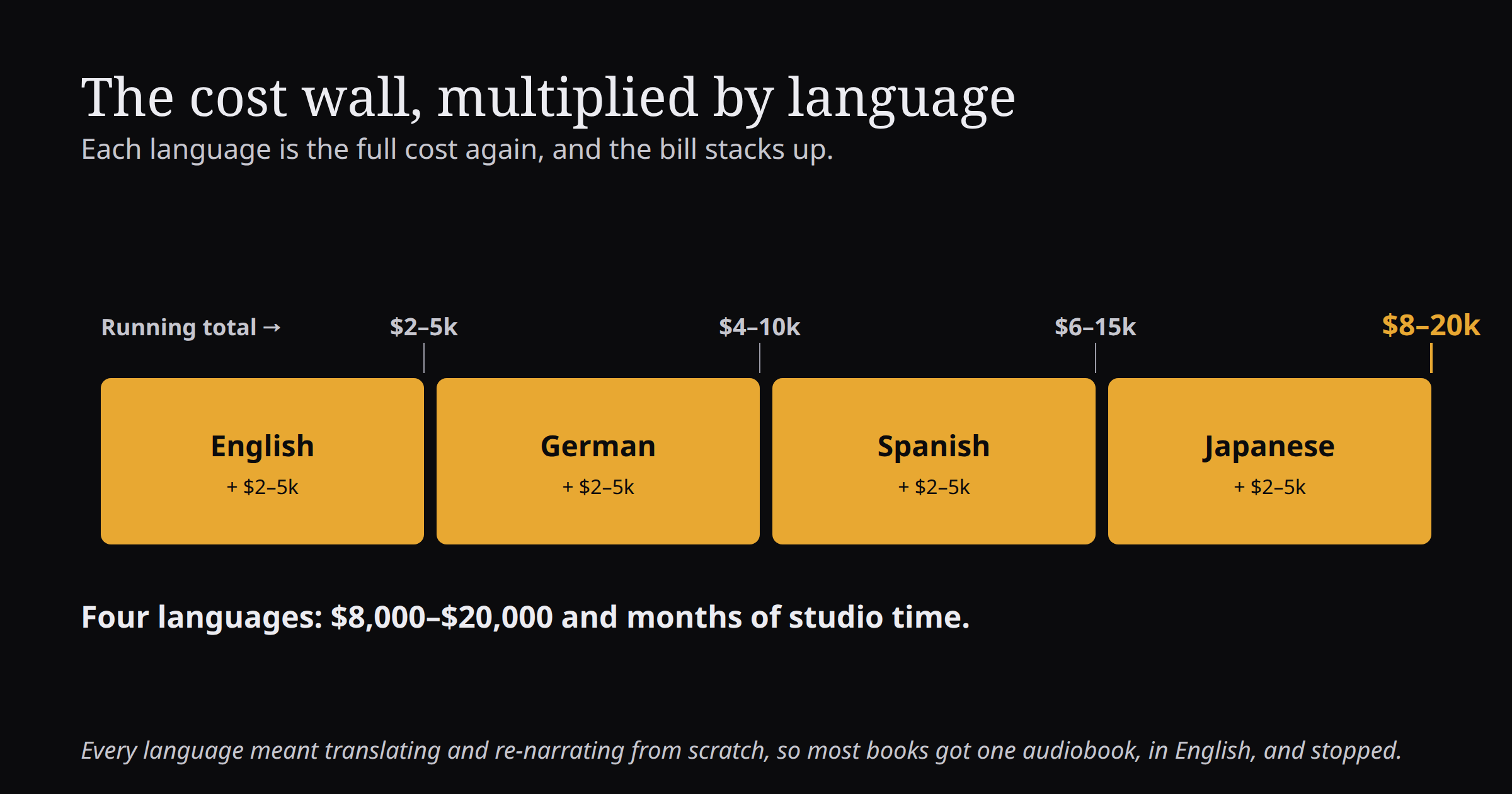
A professional narrator costs about $250 per finished hour, the SAG-AFTRA union minimum on ACX, and that's the floor, not the ceiling. A typical novel runs eight to eleven finished hours, and by the rough six-to-one rule, each finished hour takes about six hours of work to record, edit, proof, and master. So one English audiobook lands between $2,000 and $5,000 and takes four to eight weeks of studio time. In practice it takes months, because first you wait for a narrator worth hiring to be free.
Now do it again in German. Then Spanish, then Japanese. Each language meant paying twice: once to translate the book, once to re-narrate it with a native voice. The cost didn't add, it multiplied. So publishers made the English audiobook, sometimes, and stopped. Your novel sold in German print while its audio rights sat untouched, because the spreadsheet never closed.
Cheap arrived, and most of it was slop
Then the free tools showed up. Google Play Books will auto-narrate your manuscript at no cost and let you sell the file elsewhere. Apple Books does the same, in English only, with the Apple-narrated version distributed through Apple Books (you keep the rights to make your own elsewhere). Audible's Virtual Voice does it inside Kindle. Suddenly anyone could make an audiobook for nothing.
The catch is what "for nothing" produces. These tools run raw text-to-speech straight off your file. Nobody prepares the manuscript first, so footnotes, headings, and abbreviations get read aloud as written. There is no editing pass and no revisions. The voice is clear but flat. It reads words, it doesn't perform them. And the cheapest options either take a slice of your royalties or trap the file in one store.
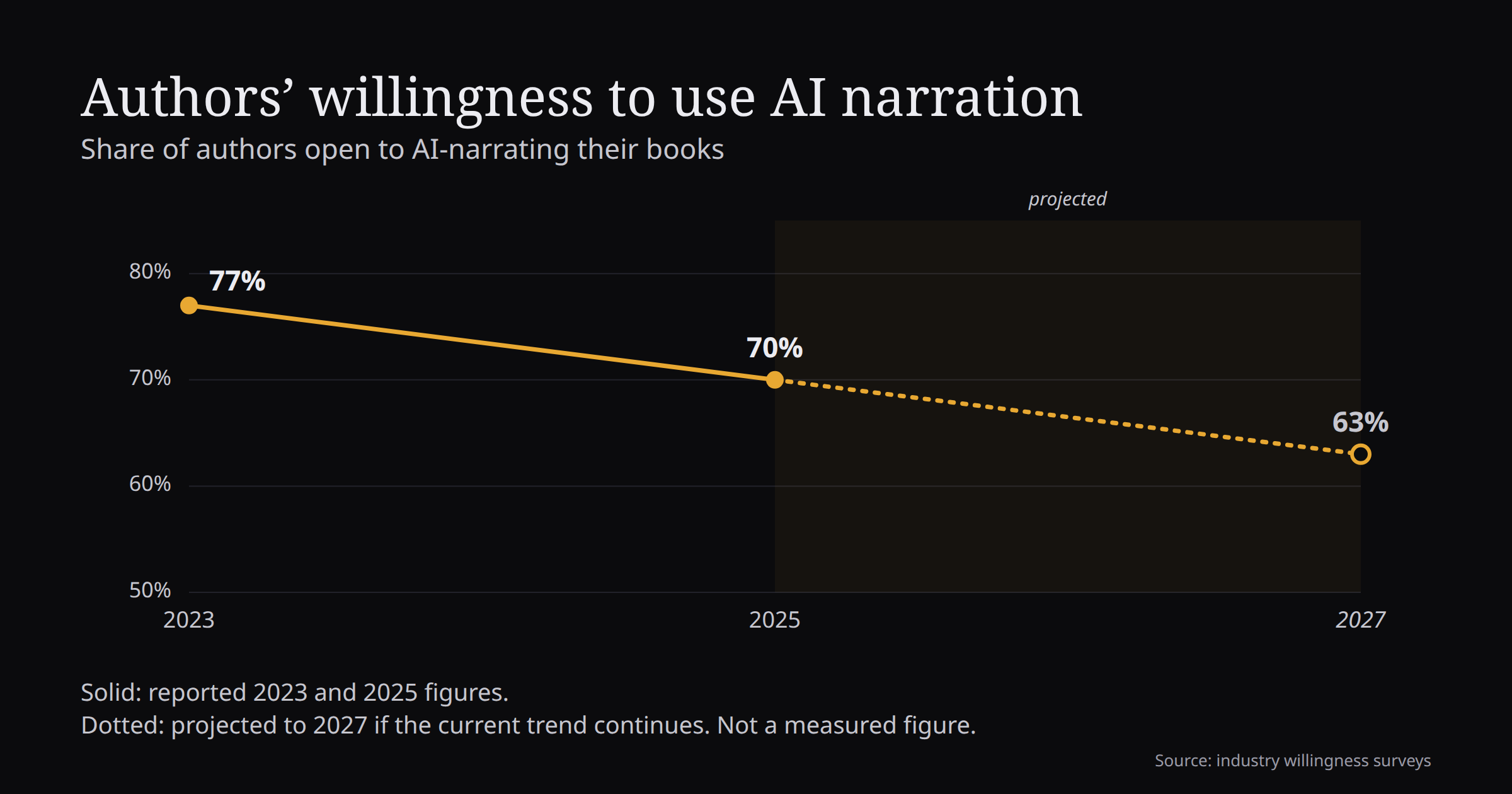
The result was a flood: tens of thousands of hastily made audiobooks, generated by systems built for speed over quality, clarity over cadence, dramatic exaggeration over any sense of context. Authors noticed. Their willingness to use AI narration has fallen as the supply grew, not risen: 77 percent in 2023, down to 70 percent in 2025, with AI titles still a fraction of a percent of sales. The technology didn't poison the well. Careless uses of it did.
Doing it right
That gap is the whole reason TomeVox exists, and the fixes aren't exotic. They're the steps the free tools skip.
Start with performance. TomeVox narrates for drama, not just clarity. It reads dialogue as dialogue, shifts for quoted and first-person passages, and paces a scene the way a person would, instead of flattening every line to one pitch. That is the difference between a voice that reads your words and one that performs them, and it is why this works for fiction, not only business books.
Then preparation. Every manuscript goes through a preparation step before a single word is narrated, so structure, abbreviations, and names are handled up front and the narration reads the book rather than the markup. Pronunciation is part of that. Most AI mangles names, places, and words with more than one valid reading; our process is built specifically to avoid it, a review pass catches anything that slips through, and you can ask us to correct whatever we miss. There is a review and there are revisions at the end, not a one-shot export you are stuck with. The first chapter is free, so you hear the voice on your own book before you pay for the rest.
And this isn't English with a few extras bolted on. TomeVox narrates in thirteen languages across more than 200 voices, with real regional range where it counts: eight Arabic varieties from Modern Standard to Egyptian, Gulf, and Levantine; five Spanish accents from Castilian to Mexican to Caribbean; Mandarin, Cantonese, and Hokkien for Chinese. Your reader in Cairo and your reader in Mexico City don't get handed the same generic voice.
What you walk away with is a file you own: a flat fee per book, M4B with chapter markers plus MP3, full commercial rights, no royalty share, and no store lock-in. The EU AI Act's Article 50 transparency obligations start applying on August 2, 2026, with fines up to fifteen million euros, so TomeVox discloses cleanly and you stay on the right side of it.
Where this leaves you
Most books still have no audiobook, in any language, and the one reason they didn't is finally gone. The way to take that opening is not the fastest, cheapest tool that reads your words flat and locks the file away. It is making one good audiobook, then making it exist in the languages your readers actually speak.
That is the workflow we wrote up separately in how to translate your book and make a foreign-language audiobook, and for where these files are allowed to go, start with the platform guide. You can hear the difference on your own first chapter, free.
The audiobook nobody made was a math problem. The math changed. The shelf is still empty. Go put your book on it.
Hear your book before you decide
Upload your manuscript and get your first chapter narrated free, in any of thirteen languages. No credit card, no commitment.
Try TomeVox FreeCommon questions about cheap and multilingual audiobooks
Can you make an audiobook in a language you don't speak?
Yes. With AI narration and translation you can produce an audiobook in a language you don't read or speak. TomeVox narrates in thirteen languages, and you hear a free first chapter before you commit, so you can judge the result even if you can't judge the accent yourself.
How much does an AI audiobook cost compared with hiring a narrator?
Hiring a professional narrator for a typical novel runs about $2,000 to $5,000 and takes four to eight weeks of studio time, plus the wait to book the narrator. TomeVox charges a flat fee per book with no royalty share, and you keep full commercial rights to the files.
Is AI narration good enough for fiction?
Most AI narration is flat, which is why it struggles with fiction. TomeVox narrates for performance: dialogue, quoted speech, and first-person passages are paced like a reading rather than flattened to one pitch, so it holds up for fiction, not only nonfiction.
Do you have to disclose AI narration?
Yes. Many platforms require it, and the EU AI Act's Article 50 transparency obligations start applying on August 2, 2026, making labeling AI-generated audio a legal requirement in Europe. TomeVox discloses cleanly so your book stays compliant wherever you sell it.
What languages and accents does TomeVox support?
Thirteen languages and more than 200 voices, with regional accents where they matter: eight Arabic varieties, five Spanish accents, five English accents, and Mandarin, Cantonese, and Hokkien for Chinese, among others.